
【PRESS RELEASE】Quemix and Nissan Begin Joint Research and Development of Quantum Computing Software for Aerodynamic Simulation
Successfully Develop Technology Enabling Aerodynamic Simulation of Vehicle Geometries
June 1, 2026


Quemix Inc. (“Quemix”; Head Office: Nihonbashi, Chuo-ku, Tokyo; CEO: Yu-ichiro Matsushita), a company engaged in the research and development of quantum computing algorithms and software, and Nissan Motor Co., Ltd. (“Nissan”; Head Office: Yokohama City, Kanagawa; President & CEO: Ivan Espinosa), have launched a joint research project aimed at developing next-generation aerodynamic analysis software utilizing quantum computers.
Assuming execution on Early Fault-Tolerant Quantum Computers (Early-FTQC), Quemix and Nissan have developed a new hybrid quantum-classical algorithm capable of handling the complex geometries of vehicle bodies. Through execution on a simulator, the companies confirmed that the new approach can reproduce the results of conventional aerodynamic analyses performed using classical computers with high accuracy. The two companies have also jointly filed patent applications related to the results of this research.
【Background and Challenges】
As the automotive industry advances toward carbon neutrality, improving aerodynamic performance has become an extremely important challenge for enhancing fuel efficiency (or energy efficiency in EVs) and extending driving range. Currently, the Lattice Boltzmann Method (LBM) is widely used as a mainstream simulation technique for aerodynamic analysis. However, applying quantum computing to this field has involved several unique technical challenges.
Many conventional quantum fluid dynamics algorithms assume closed spaces composed of “simple cubic structures” or “regular lattices” in order to simplify calculations. As a result, incorporating “boundary conditions” associated with the complex curved surfaces of vehicle geometries into the quantum computation process (unitary operations) has been extremely difficult.
More specifically, when accurately reflecting complex object geometries or applying non-zero (non-homogeneous) boundary conditions at object boundaries, the resulting quantum circuits become enormously large and highly complex. This has represented a major obstacle to practical implementation, as current and near-term quantum devices — including Early Fault-Tolerant Quantum Computers (Early-FTQC) — cannot simultaneously achieve manageable computational workloads and maintain sufficient calculation accuracy under such conditions.
【Newly Developed Technology and Research Results】
In this joint research project, the companies developed and demonstrated the following technologies to efficiently process complex object geometries and boundary conditions on quantum computers.
Development of a Hybrid Quantum-Classical Algorithm
The researchers developed a new hybrid quantum-classical algorithm in which classical computers handle calculations associated with inflow/outflow conditions and object motion (processing of non-homogeneous terms), while quantum computers are responsible for the core fluid dynamics calculations, including the treatment of stationary object boundaries.This approach enables execution on Early Fault-Tolerant Quantum Computers (Early-FTQC), where computational resources remain limited.
High-Accuracy Simulation Assuming Vehicle Geometries
Using the proposed algorithm, the researchers conducted aerodynamic simulations on a quantum simulator assuming the complex geometries of vehicles. The results confirmed that the proposed method can reproduce the outcomes of conventional aerodynamic analysis techniques using classical computers with high accuracy.
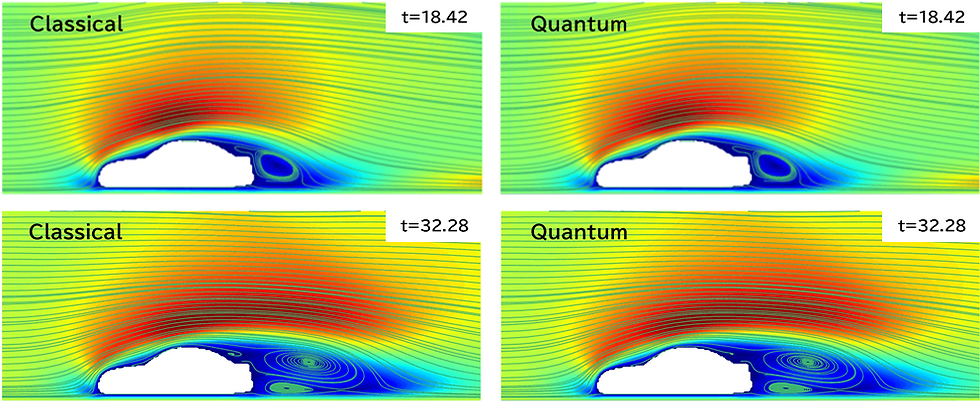
Comparison of aerodynamic analysis results for a vehicle model
Calculation results obtained using the proposed algorithm (quantum simulator). The airflow around complex vehicle geometries was reproduced with accuracy comparable to that of conventional classical LBM simulations, demonstrating the potential of quantum computers for practical fluid dynamics analysis.
Versatility and Intellectual Property
This technology is not limited to automotive aerodynamic analysis and has broad applicability to fluid dynamics simulations involving complex geometries across various fields, including aerospace, marine engineering, and architecture.
Based on the results of this research, Quemix and Nissan have jointly completed patent applications related to the developed technology.
【Future Outlook】
Building on the results of this study, Quemix and Nissan will further accelerate their joint research efforts. Going forward, the companies aim to achieve the practical implementation of aerodynamic simulation software on quantum computers and promote its application to aerodynamic analysis within actual vehicle development processes.
Through these efforts, Quemix and Nissan seek to drive a paradigm shift in computational technologies for the automotive industry.
The results of this joint research are scheduled to be presented by researchers from Quemix and Nissan in the Case Study Track at “Q2B 2026 Tokyo,” an international conference on quantum technologies to be held at the Grand Hyatt Tokyo on June 4–5, 2026.
Q2B 2026 Tokyo Official Website: https://q2b.qcware.com/conference/2026-tokyo
About Quemix Inc.
Quemix Inc., a consolidated subsidiary of TerraSky Co., Ltd. (Headquarters: Chuo-ku, Tokyo; CEO: Hideya Sato), conducts research and development in quantum computing, quantum sensing, and computational materials science.
Under its vision of “realizing the future humanity has dreamed of through quantum technology,” Quemix supports breakthrough innovations for companies leading the next generation of quantum technologies.
Since its establishment in 2019, the company has focused on research and development of algorithms for fault-tolerant quantum computers (FTQC), including the development and patenting of the “Probabilistic Imaginary-Time Evolution (PITE®)” quantum chemistry algorithm, which has been mathematically proven to achieve quantum acceleration.
As a leading company in FTQC algorithm research in Japan, Quemix is actively advancing research and development aimed at the practical application of quantum computing in materials computation and simulation by 2030.
Contact Information
Quemix Inc.
Inquiry Form: https://www.quemix.com/en/contact


