
【PRESS RELEASE】Quemix, Toyota, Toyota Central R&D Labs., and The University of Tokyo Demonstrate Efficient Task Allocation in Quantum Chemistry Calculations Using Classical-Quantum Hybrid Computing
Pushing Classical Computing to Its Limits for Ground-State Calculations, Then Reaching the True Solution with Quantum Computing
June 1, 2026
Quemix Inc.
Quemix Inc. (“Quemix”; Head Office: Nihonbashi, Chuo-ku, Tokyo; CEO: Yu-ichiro Matsushita), a company engaged in the research and development of quantum computing algorithms and software, Toyota Motor Corporation (Head Office: Toyota City, Aichi Prefecture; Representative: Kenta Kon), Toyota Central R&D Labs., Inc. (Head Office: Nagakute City, Aichi Prefecture; President and CRO: Takashi Shimazu), and the Graduate School of Science, The University of Tokyo (Location: Bunkyo-ku, Tokyo; President: Teruo Fujii), have conducted a proof-of-concept study investigating efficient task allocation between classical and quantum computers in quantum chemistry calculations using quantum computers.
As a result of this joint research, the collaborators presented new guidelines for the “efficient allocation of computational resources” to maximize the strengths of both classical and quantum computing devices by combining the Density Matrix Renormalization Group (DMRG) method with the Probabilistic Imaginary-Time Evolution (PITE) method.
【Background: The Challenge of “State Preparation” in Quantum Chemistry Calculations】
In recent years, high-precision quantum chemistry calculations using quantum computers have attracted significant attention. Because the electronic states of molecules obey quantum mechanics, they can naturally be represented on qubits operating under the same principles, potentially enabling precise simulations of complex electronic behaviors that are difficult to calculate using conventional classical computers. As a result, quantum computers are expected to accelerate the development of high-performance new materials.
A central challenge in quantum chemistry calculations is identifying the “ground state,” the state with the minimum energy. Once the ground state is obtained, various physical properties can be derived, including molecular reactivity and experimentally observable spectra. Quantum Phase Estimation (QPE) is widely known as a representative quantum algorithm for ground-state calculations, and Quemix has proposed its proprietary quantum algorithm, the “Probabilistic Imaginary-Time Evolution (PITE)” method*1, to further accelerate such calculations.
However, “state preparation” has remained a common challenge. In many cases, the initial state is generated from solutions obtained by mean-field approximation calculations*2 performed on classical computers. Problems that cannot be accurately treated using mean-field approximations are precisely those where quantum computers can provide the greatest benefits through high-precision calculations. However, for such problems, the mean-field approximation solution is often far from the true ground state. Using such a state as the initial input significantly increases the computational cost on quantum computers, including longer execution times and higher error risks.
Therefore, the practical realization of quantum chemistry calculations depends critically on how closely the initial state can approximate the true solution.
At the same time, preparing high-quality initial states on quantum computers has long faced two major challenges. First, obtaining highly accurate initial states on classical computers becomes exponentially more computationally expensive as the system size increases. Second, even if a good quantum state can be generated classically, encoding that state onto a quantum computer also requires enormous computational resources.
As a result, fundamental questions remained unresolved:
To what extent should high-quality initial states be prepared on classical computers?
How much computational cost should be allocated to state preparation and subsequent ground-state calculations on quantum computers?
In other words, an efficient task allocation strategy between classical and quantum devices had yet to be clarified. As hybrid computing architectures integrating classical and quantum computers gain attention as next-generation computational platforms, establishing an effective division of tasks between the two has become an issue of critical practical importance.
【Proof-of-Concept Study: Exploring the Optimal Balance Between Classical and Quantum Computing】
In this study, the researchers experimentally clarified the boundary between “what should be prepared using classical computers” and “what should be delegated to quantum computers” for a single computational problem.
Results of the Demonstration Study Thorough Classical-Side Optimization:For ground-state calculations, the study demonstrated that maximizing processing on classical computers directly contributes to overall efficiency improvements. Specifically, the researchers employed the Density Matrix Renormalization Group (DMRG) method*3, a highly accurate computational method already established for classical computers, to approach the true ground state as closely as possible within the limits of classical computational memory and cost.
Seamless Integration and the Benefits of Quantum Computing The highly accurate state obtained on the classical computer side was encoded into a quantum circuit as a Matrix Product State (MPS) through state preparation and subsequently passed to Quemix’s proprietary quantum algorithm, PITE.
Overcoming the Limits of Classical Computing with Quantum Computing For large-scale problems, attempting to reach the exact solution using only classical computers eventually becomes computationally infeasible. This study demonstrated the possibility of reaching the “true solution,” which could not be achieved by classical computation alone, by assigning the remaining computationally challenging region to quantum computers after first approaching the true solution as closely as possible using classical methods.
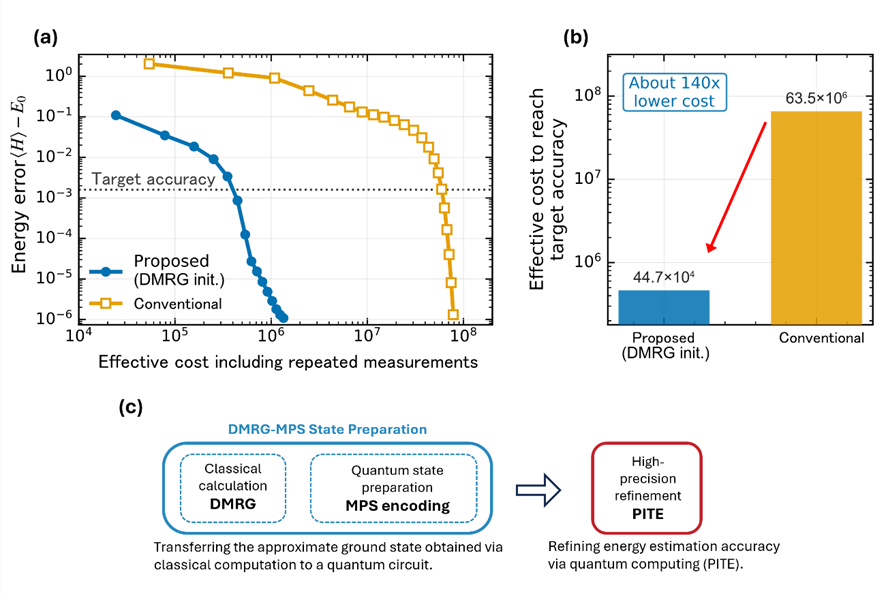
Figure 1: Improving the efficiency of ground-state calculations by combining DMRG-MPS initial states with Probabilistic Imaginary-Time Evolution (PITE). The Matrix Product State (MPS) obtained by DMRG is used as the initial state of the quantum circuit, and PITE is then applied to approach a highly accurate ground state. Compared with the conventional approach using a Néel initial state, the proposed method achieves the target accuracy with a significantly lower effective computational cost. In this one-dimensional Heisenberg model example with 16 spins, the required computational cost was reduced to approximately 1/140 of the conventional method. The lower panel illustrates the workflow of the proposed method.
【Significance of the Research Results: Practical Guidelines for Hybrid Operation*4】
This study reaffirmed that, while quantum computers are powerful, their benefits cannot be fully realized if the initial state is insufficiently prepared. By providing concrete guidance on how computational resources should be allocated between classical and quantum computers in future quantum chemistry calculations, this research represents a significant step toward practical application.Quemix and its partners will continue to promote algorithm development for the practical application of quantum chemistry calculations and contribute to solving social challenges through advances in materials development.
The results of this joint research are scheduled to be presented at Q2B 2026 Tokyo, an international conference on quantum technologies to be held at the Grand Hyatt Tokyo on June 4–5, 2026.
Q2B 2026 Tokyo Official Website
*1 Probabilistic Imaginary-Time Evolution (PITE): A quantum algorithm being developed by Quemix to efficiently extract ground states.
*2 Mean-field approximation calculation: An approximate calculation method that can be handled by classical computers at low computational cost. Representative examples include density functional theory calculations.
*3 Density Matrix Renormalization Group (DMRG): An algorithm for highly accurate treatment of strongly correlated electron systems on classical computers.
*4 HPC-QC hybrid: A computational framework that integrates high-performance computing (HPC), such as supercomputers, with quantum computers (QC).
About Quemix Inc.
Quemix Inc., a consolidated subsidiary of TerraSky Co., Ltd. (Headquarters: Chuo-ku, Tokyo; CEO: Hideya Sato), conducts research and development in quantum computing, quantum sensing, and computational materials science.
Under its vision of “realizing the future humanity has dreamed of through quantum technology,” Quemix supports breakthrough innovations for companies leading the next generation of quantum technologies.
Since its establishment in 2019, the company has focused on research and development of algorithms for fault-tolerant quantum computers (FTQC), including the development and patenting of the “Probabilistic Imaginary-Time Evolution (PITE®)” quantum chemistry algorithm, which has been mathematically proven to achieve quantum acceleration.
As a leading company in FTQC algorithm research in Japan, Quemix is actively advancing research and development aimed at the practical application of quantum computing in materials computation and simulation by 2030.
Contact Information
Quemix Inc.
Inquiry Form: https://www.quemix.com/en/contact


Comments