

RESEARCH PAPER
Quemix pursues the full potential of quantum technology, ranging from research into quantum algorithms that maximize the performance of quantum computers and advanced materials simulation software to the development of quantum sensors that enable unprecedented measurement capabilities. By widely sharing our expertise, we aim to accelerate the realization of a future society shaped by quantum technology.
Search for Papers
A maximum of 12 papers can be displayed on this page at one time (the 12 most recent papers are displayed by default). Please use the search function to view older papers.
2026-09-30
First-quantized quantum simulation with non-local potentials by matrix-product-state encoding
Kazuki Tsuoka, Taichi Kosugi, Masari Watanabe, Hirofumi Nishi, Yu-ichiro Matsushita
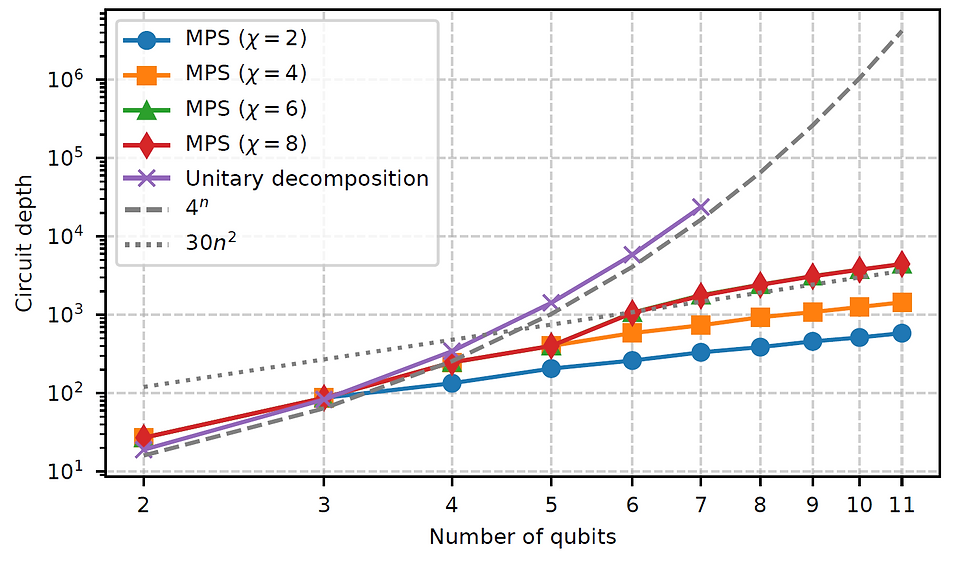
This study proposes a new method using Matrix Product State (MPS) encoding to efficiently handle pseudopotentials—which typically pose implementation challenges for quantum circuits due to their non-local nature—within the framework of first-quantized quantum simulation. By representing the non-local potential as a low-rank MPS and mapping it directly onto the quantum circuit, the circuit depth is reduced.
Application of this method to an ionization model involving the irradiation of a one-dimensional hydrogen atom with an ultrashort-pulse laser confirmed a significant reduction in circuit depth compared to direct unitary decomposition. In a 7-qubit example, the circuit depth was reduced from 23,775 to 1,747, demonstrating the method's effectiveness for the efficient implementation of non-local potentials in first-quantized quantum simulations.

2026-09-30
An atom-based machine-learned dipole-moment model and application to conjugated systems
Yuansheng Zhao, Tamio Yamazaki, Ryohei Hosoya, Yu-ichiro Matsushita, Shinji Tsuneyuki
In this study, we propose a new method that defines "Effective Atomic Dipoles (EAD)"—derived from DFT wavefunctions by decomposing the total molecular dipole moment into atomic contributions—and predicts them using a graph neural network (GNN) based on atomic structure.
We have confirmed that this method can predict dipole moments and dielectric functions with high accuracy, even for complex conjugated systems that were difficult to handle with conventional bond-based models. Furthermore, the computational cost of this method scales linearly with the number of atoms; it is approximately three times faster than methods based on Born effective charges (BEC) while demonstrating comparable or superior accuracy in the terahertz frequency range.
Submitted to arXiv on September 30, 2026.

2026-09-03
Orbital-Free DFT-Assisted Machine-Learned Molecular Dynamics for Electric-Field-Driven Ionic Transport
Yusuke Nishiya, Hiroya Nakata, Yosuke Harada, Yu-ichiro Matsushita
This study proposes a molecular dynamics method in which field-independent interatomic forces are evaluated using a machine-learning potential, while atom-specific charges that respond to local environments are obtained from orbital-free density functional theory (OFDFT). Applied to an S₈/Li₃PS₄ interface, the method reproduces electric-field-driven Li-ion migration and the accompanying negative charging of S atoms. The results indicate that electric-field-driven ionic transport and changes in interfacial charge states can be treated efficiently without training a separate charge-prediction model for each material.

2026-09-03
Origin of shallow hole traps at GaN/SiO₂ interface studied from density functional theory
Yuansheng Zhao, Atsushi Oshiyama, Kenji Shiraishi
This study investigates the origin of shallow hole traps at the GaN/SiO₂ interface, a key challenge for GaN-based MOSFETs, using first-principles calculations with realistic interface models. Even in the absence of point defects such as oxygen vacancies, tail states originating from undercoordinated O atoms in a naturally formed amorphous GaOₓ layer at the interface can capture holes. Elongation of Ga–O bonds shifts these electronic states into the GaN band gap, leading to the formation of shallow hole traps.
Published in Physical Review Materials on September 3, 2026

2026-06-02
An efficient quantum Hadamard product algorithm for functions
Xinchi Huang, Hirofumi Nishi, Tomofumi Zushi, Yu-ichiro Matsushita
This study proposes a quantum algorithm for efficiently preparing a quantum Hadamard-product state corresponding to the element-wise product of two quantum states whose amplitudes encode function values. In conventional postselection-based methods, the success probability decreases inversely with the number of grid points, increasing the number of queries for large grids. The proposed approach treats the input functions in Fourier space and interprets the Hadamard product as a convolution, allowing approximate circuits to be constructed using localized Fourier coefficients. As a result, the computational cost depends on the smoothness of the functions and the localization of their Fourier coefficients rather than directly on the number of grid points. In particular, when at least one input function has a finite number of nonzero Fourier coefficients, the exact Hadamard-product state can be prepared with query complexity independent of the grid size. The study also proposes a new quantum circuit for efficiently evaluating partial inner products.

2026-05-28
Quantum algorithms for density functional theory with minimal readout
Yuansheng Zhao, Hirofumi Nishi, Taichi Kosugi, Satoshi Hirose, Hiroki Sakagami, Tatsuki Oikawa, Tatsuya Okayama, Yu-ichiro Matsushita
This study proposes quantum algorithms that minimize the cost of reading out the electron density, a key bottleneck in density functional theory (DFT) calculations on quantum computers.
In Kohn–Sham DFT, the electron density must be constructed from occupied orbitals and fed back into the self-consistent-field (SCF) cycle. On a quantum computer, however, measurement collapses the quantum state, making repeated density readout and Hamiltonian updates a significant bottleneck. To address this, the study develops a qubit-efficient encoding of Kohn–Sham orbitals together with an adiabatic real-time evolution (ATE)-based quantum algorithm that obtains multiple occupied orbitals simultaneously.
The work further exploits the Harris functional, a non-SCF DFT approach that is well suited to quantum computation. Because the double-counting correction required for total-energy evaluation can be calculated classically from a known input density, the Harris functional eliminates the need to read out the electron density from the quantum state. This allows band energies to be evaluated efficiently on a quantum computer while avoiding electron-density readout entirely. The study also proposes variational adjustment of the input density to improve the accuracy of the Harris functional.
Numerical demonstrations for LiH and body-centered-cubic Li reproduce conventional classical results for Harris-functional calculations, k-point sampling, and band structures. The study additionally proposes an SCF scheme using multiple copies of the wavefunction that avoids direct electron-density readout and validates it for LiH. The work provides concrete algorithms for reducing the readout bottleneck in quantum-accelerated DFT.

2026-05-28
End-to-End Molecular Dynamics with a Langevin Thermostat on Quantum Circuits
Masari Watanabe, Hirofumi Nishi, Taichi Kosugi, Shigekazu Hidaka, Ryo Sakurai, Yu-ichiro Matsushita
This study develops a molecular dynamics (MD) framework for the canonical (NVT) ensemble on quantum circuits using a Langevin thermostat.
The method encodes the classical nuclear phase-space distribution as a quantum state using the Koopman–von Neumann (KvN) wavefunction formalism and formulates canonical-state preparation as Langevin-type Fokker–Planck relaxation. On quantum circuits, Hamiltonian Liouville flow, momentum friction, and momentum diffusion are decomposed into separate circuit blocks. The friction term is implemented as a symmetrized dilation in momentum space, while the diffusion term is implemented as a cosine filter based on probabilistic imaginary-time evolution (PITE).
The study also analyzes the temperature bias introduced when a Gaussian diffusion kernel is replaced by the cosine filter realized by PITE and introduces an internal-temperature correction to recover the equilibrium distribution at the target physical temperature. This establishes a complete workflow for preparing a KvN state corresponding to the canonical distribution on a quantum circuit and reading out molecular-dynamics observables from that state.
As a demonstration, the method is applied to H₂, connecting a Born–Oppenheimer potential and Hellmann–Feynman forces obtained from a one-qubit Pauli Hamiltonian to KvN nuclear dynamics. Numerical simulations confirm relaxation from a nonequilibrium phase-space distribution to the canonical KvN state. From the resulting canonical state, the study further demonstrates quantum-phase-estimation (QPE) readout of the vibrational density of states (VDOS) associated with H–H stretching and a static evaluation of a reaction-rate constant based on transition-state theory (TST). The work provides a concrete circuit-level approach toward quantum–classical hybrid molecular dynamics spanning electronic-structure calculations, finite-temperature nuclear dynamics, and the readout of molecular-dynamics properties.

2026-05-28
Overcoming the Matrix-Product-State Encoding Barrier via DMRG-Guided Probabilistic Imaginary-Time Evolution
Masari Watanabe, Hirofumi Nishi, Taichi Kosugi, Shinji Tsuneyuki, Yu-ichiro Matsushita
This study proposes a three-stage hybrid method combining the density-matrix renormalization group (DMRG), matrix-product-state (MPS) encoding, and probabilistic imaginary-time evolution (PITE) to improve the efficiency of ground-state preparation in quantum simulation.
In quantum algorithms, the overlap of the initial state with the true ground state strongly affects the success probability, measurement cost, and postselection overhead of subsequent calculations. The proposed framework first prepares an MPS obtained by DMRG, loads it into a quantum register using a matrix-product-disentangler (MPD) encoding circuit that requires no optimization, and then applies PITE to suppress the remaining excited-state components.
The study also shows that the growth of the central-bond Schmidt rank during MPS encoding follows a logistic curve and that its inflection point, L*, serves as a boundary for the efficient encoding regime. Because pushing the encoding beyond L* requires a large increase in circuit depth for only incremental accuracy gains, the method stops encoding at L* and uses PITE to remove the residual error.
Numerical experiments on a spin-1/2 Heisenberg chain with a staggered magnetic field demonstrate that using a DMRG-derived MPS as the initial state maintains a higher cumulative success probability in PITE than starting from a Néel product state, thereby reducing the effective circuit cost when postselection is taken into account. The work presents a practical ground-state preparation strategy that bridges classical tensor-network calculations and non-variational quantum projection algorithms.

2026-05-28
Channel-agnostic finite-temperature phase estimation averaged over variable grids: reconstruction of Green’s function for dynamical mean-field theory
Taichi Kosugi, Hirofumi Nishi, Keito Kasebayashi, Hiroki Takahashi, Yu-ichiro Matsushita
This study proposes a quantum–classical hybrid scheme for treating strongly correlated electron systems by combining dynamical mean-field theory (DMFT), quantum phase estimation (QPE), and the variable-grid averaging method QAVG (QPE averaged over variable grids).
DMFT is an important computational framework for strongly correlated materials, but conventional classical calculations can be costly when high-accuracy Green's functions for the correlated subsystem are required. For finite-temperature one-particle Green's functions, the study constructs a modified QPE circuit that extracts spectral amplitudes and excitation energies without identifying which excitation channel occurred in each measurement.
The QAVG method is further extended to finite-temperature systems. Using histograms obtained from QPE measurements, QAVG reconstructs the Green's function while optimizing trial parameters. This reduces bias arising from the finite grid resolution of QPE and allows the Green's function to be estimated with fewer parameters than the actual number of excitation channels.
The method is incorporated into a DFT+DMFT workflow and tested numerically for SrVO₃, a representative strongly correlated material. The resulting QAVG-DMFT calculations reproduce the overall spectral features obtained with FCI-DMFT. The work establishes a foundation for using quantum computers as impurity solvers in first-principles calculations of strongly correlated electron systems in the early fault-tolerant quantum computing era.

2026-05-28
Error-corrected phase estimation averaged over variable grids on a trapped-ion quantum computer: hyperacuity spectra of a CO molecule adsorbed onto χ-Fe5C2
Taichi Kosugi, Hirofumi Nishi, Keito Kasebayashi, Hiroki Takahashi, Yu-ichiro Matsushita
This study proposes QAVG (QPE averaged over variable grids), a variable-grid averaging approach for quantum phase estimation (QPE) that mitigates the limited grid resolution and hardware noise encountered when calculating excitation spectra of many-electron systems on current quantum devices.
QAVG combines low-resolution QPE with multiple shifts of the energy origin and a physically motivated continuous parameterization to reconstruct spectra with accuracy beyond the nominal QPE grid resolution. The method is applied to CO adsorbed on a χ-Fe₅C₂ surface in a workflow that constructs maximally localized Wannier orbitals from DFT calculations and maps the resulting effective model to quantum computation.
The study also performs hardware experiments on Quantinuum H2-2 using both physical QPE circuits and logical QPE circuits based on the Steane code. Even with noisy measurement histograms, QAVG reconstructs spectra with deviations smaller than the nominal QPE resolution. Averaging over shifted grids also suppresses local minima in the cost function caused by spectral leakage, stabilizing parameter optimization. The work contributes toward practical correlated-electron spectral calculations in the early fault-tolerant quantum computing era.

2026-05-28
Koopman–von Neumann Molecular Dynamics for Green–Kubo Transport Coefficients
Masari Watanabe, Hirofumi Nishi, Taichi Kosugi, Shigekazu Hidaka, Ryo Sakurai, Yu-ichiro Matsushita
This study formulates the calculation of Green–Kubo transport coefficients in classical molecular dynamics (MD) as a quantum-algorithm readout problem using the Koopman–von Neumann (KvN) representation.
In the Green–Kubo relation, transport coefficients such as diffusion and viscosity are evaluated as time integrals of equilibrium flux correlation functions. The study represents classical MD time evolution as unitary evolution in Hilbert space via the KvN formalism and derives the corresponding KvN generators and quantum-circuit constructions for both NVE dynamics and Nosé–Hoover-type NVT dynamics.
It further shows that, by feeding a flux-excited state into quantum phase estimation (QPE), the probability P₀ of measuring the QPE ancilla register in the all-zero state corresponds to a Bartlett-windowed Green–Kubo integral. This recasts transport-coefficient evaluation from sequential integration of time-correlation functions into the estimation of a probability defined by QPE.
Numerical benchmarks show that the discretization error of the correlation function on a finite grid decreases as a power law with the number of grid points. In addition, maximum-likelihood amplitude estimation (MLAE) improves the query scaling for estimating P₀ from the Nqueries^-1/2 behavior of direct sampling toward Nqueries^-1. This work provides a concrete step toward connecting quantum algorithms with transport-coefficient calculations required in practical molecular simulation.

2026-05-27
Problem-Specific Basis Quantum State Readout via Proper Orthogonal Decomposition
Kota Ichiki, Xinchi Huang, Gekko Budiutama, Masari Watanabe, Yoshifumi Kawada, Ryunosuke Terasawa, Hirofumi Nishi, Takayuki Suzuki, Ryutaro Nagai, Yu-ichiro Matsushita
This study proposes PODR (proper orthogonal decomposition-based readout), a readout method based on proper orthogonal decomposition (POD), to reduce the cost of reconstructing classical solutions from quantum states in quantum-computer-based partial differential equation (PDE) solvers.
PODR first builds a problem-specific POD basis offline from representative CFD simulation results. In the online stage, the quantum state is projected onto this basis and only a small number of weighting coefficients are extracted. For CAE/CFD applications in which similar analyses are repeated while varying physical parameters or time, this reduces both the number of measurements and the online computational resources required for readout.
Benchmarks on two-dimensional lid-driven cavity flow and the two-dimensional Kármán vortex street show that PODR can reconstruct flow fields accurately with fewer shots than conventional real-space readout (RSR) and Fourier-space readout (FSR). The work helps alleviate the readout bottleneck in large-scale PDE analysis and CAE/CFD applications using quantum computers.
